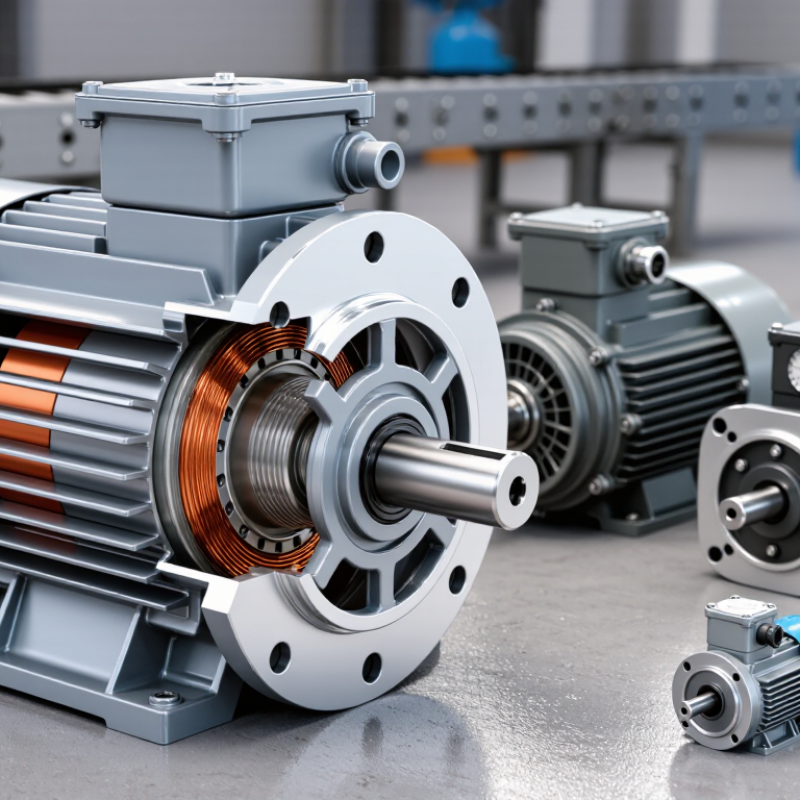
| AC Motor Types |
| Induction motor |
Three-phase squirrel-cage motor |
A rotating magnetic field in the stator induces current in the rotor. Rotor speed is slightly lower than synchronous speed, creating the slip required to produce torque.
|
Robust construction, low maintenance, self-starting, and widely available in standard frame sizes.
|
Pumps, fans, compressors, conveyors, machine tools, and general industrial machinery.
|
| Induction motor |
Single-phase induction motor |
Uses an auxiliary winding, capacitor, shaded pole, or another starting method to create starting torque from a single-phase supply.
|
Suitable for lower power ratings; starting performance and efficiency depend strongly on the design.
|
Domestic appliances, small fans, blowers, small pumps, and light-duty equipment.
|
| Synchronous motor |
Permanent-magnet synchronous motor |
The rotor magnetic field is produced by permanent magnets and rotates in synchronism with the stator field.
|
High efficiency and power density; normally requires an electronic drive for starting and speed control.
|
Servo systems, high-efficiency drives, robotics, compressors, and variable-speed equipment.
|
| Synchronous motor |
Wound-field synchronous motor |
The rotor magnetic field is generated by a DC field winding, while the stator is supplied with AC.
|
Runs at synchronous speed and can provide controllable power factor; construction and control are more complex.
|
Large industrial drives, constant-speed systems, and applications requiring power-factor correction.
|
| Electronically commutated motor |
Brushless DC motor |
Uses permanent magnets and electronic commutation instead of mechanical brushes and a commutator.
|
Efficient, quiet, and controllable; requires an electronic controller and is not normally connected directly to the AC supply.
|
Fans, pumps, appliances, automation equipment, and compact variable-speed systems.
|
| Important AC Motor Ratings and Performance Terms |
| Rated power |
Output power, expressed in kW |
The mechanical power available at the motor shaft under its specified rated operating conditions.
|
Electrical input power is higher than shaft output because of stator, rotor, core, friction, windage, and other losses.
|
Motor selection should consider continuous load, starting demand, overload requirements, and service conditions.
|
| Rated voltage |
Supply voltage, expressed in V |
The voltage for which the motor windings and insulation system are designed.
|
Common industrial systems include low-voltage three-phase supplies such as 400 V at 50 Hz, but actual values vary by region and installation.
|
The supply voltage, connection method, and permissible voltage tolerance must match the motor nameplate.
|
| Rated frequency |
Supply frequency, expressed in Hz |
The frequency of the AC supply used to establish the motor's magnetic field and base speed.
|
Common utility frequencies are 50 Hz and 60 Hz. A variable-frequency drive can change operating frequency and speed.
|
Frequency changes affect speed, torque capability, cooling, losses, and operating limits.
|
| Speed |
Synchronous and actual speed, expressed in rpm |
Synchronous speed is calculated as ns = 120f / p, where f is frequency in Hz and p is the number of poles.
|
At 50 Hz, synchronous speed is 3,000 rpm for 2 poles, 1,500 rpm for 4 poles, 1,000 rpm for 6 poles, and 750 rpm for 8 poles. An induction motor runs slightly below these values.
|
Actual speed depends on load, slip, frequency, voltage, motor design, and control method.
|
| Efficiency |
η, expressed as a percentage |
Efficiency is the ratio of mechanical shaft output power to electrical input power: η = Pout / Pin × 100%.
|
Efficiency varies with motor size, speed, load, temperature, voltage, frequency, and operating point.
|
Comparing efficiency at the same rated power, speed, load point, and test method is essential.
|
| Power factor |
cos φ |
Indicates how effectively the motor converts apparent power into active power in an AC system.
|
Induction motors generally have a lower power factor at light load and a higher power factor near rated load.
|
Power factor affects current, cable sizing, transformer loading, and utility-system performance.
|
| Torque |
Starting, breakdown, and rated torque |
Torque is the rotational force produced at the shaft and is commonly expressed in newton-metres (N·m).
|
Available torque depends on voltage, frequency, rotor design, load, acceleration requirements, and drive settings.
|
Starting torque is particularly important for conveyors, compressors, crushers, and other high-inertia loads.
|
| International Efficiency Classes under IEC 60034-30-1 |
| Efficiency class |
IE1 Standard efficiency |
The lowest class in the IE classification scale for applicable motors.
|
Higher electrical losses and operating cost than the higher IE classes at comparable ratings.
|
May be encountered in older installations or markets where minimum-efficiency requirements do not apply.
|
| Efficiency class |
IE2 High efficiency |
Provides improved efficiency compared with IE1 for motors within the applicable standard scope.
|
A common baseline for many legacy energy-efficiency regulations and existing industrial installations.
|
Can be suitable where operating hours are moderate or where replacement constraints limit the use of higher classes.
|
| Efficiency class |
IE3 Premium efficiency |
Reduces losses compared with IE2 through improved electromagnetic design, materials, and manufacturing optimization.
|
Often offers a practical balance between purchase cost, efficiency, availability, and compatibility with common industrial systems.
|
Frequently selected for pumps, fans, compressors, conveyors, and motors with long annual operating hours.
|
| Efficiency class |
IE4 Super-premium efficiency |
Delivers lower defined losses than IE3 for applicable motor ratings and operating conditions.
|
Can reduce lifetime energy consumption, although purchase price, starting behavior, dimensions, and drive compatibility must be evaluated.
|
Appropriate for heavily used equipment where energy savings can offset the higher initial investment.
|
| Efficiency class |
IE5 Ultra-premium efficiency |
The highest class in the current IEC 60034-30-1 efficiency-class framework for applicable motor technologies and ratings.
|
Requires advanced loss-reduction methods and may be associated with permanent-magnet or other specialized motor designs.
|
Best considered for high-duty-cycle applications, tight energy targets, and systems designed for the required controller and maintenance approach.
|
| Standard interpretation |
IEC 60034-30-1 |
Defines efficiency classes and efficiency values for applicable line-operated AC motors under specified test and rating conditions.
|
IE class limits are not one fixed percentage for every motor. The required efficiency depends on rated output, number of poles, frequency, and other defined parameters.
|
Always verify the applicable edition, motor scope, rated conditions, and nameplate or technical documentation before claiming compliance.
|
| Load dependence |
Efficiency at partial load |
Motor efficiency changes as load changes because fixed losses remain present while output power decreases.
|
A high-efficiency motor may not deliver its best efficiency at very low load; oversizing can therefore reduce system performance.
|
Select the motor and control strategy based on the real load profile rather than rated power alone.
|
| Selection Considerations |
| Operating duty |
Continuous or intermittent operation |
The duty cycle describes how long the motor runs, stops, starts, accelerates, and operates under different loads.
|
Continuous operation generally increases the value of a higher-efficiency motor because energy savings accumulate over time.
|
Check the duty designation, thermal capacity, starts per hour, and cooling conditions.
|
| Speed control |
Direct-on-line or variable-frequency operation |
Direct-on-line operation uses the fixed supply frequency, while a variable-frequency drive adjusts frequency and voltage to control speed.
|
Drive operation can improve process control and system efficiency, but motor insulation, cooling, bearing currents, harmonics, and minimum speed must be considered.
|
A properly sized motor-and-drive package can reduce throttling losses in pumps and fans.
|
| Environmental conditions |
Ingress protection, cooling, temperature, and altitude |
Ambient temperature, installation altitude, dust, moisture, chemicals, and ventilation influence thermal performance and service life.
|
Rated output may need derating when cooling is restricted or ambient conditions exceed the motor's specified limits.
|
Confirm enclosure, insulation class, temperature rise, cooling method, and installation requirements.
|
 YWOO Motor